From a client's corpus to a defensible diagnosis.
Elumen is a diagnostic instrument for organizational communication. It reads what the client shares, structures it through your firm's framework, and hands you a briefing you can defend line by line.
The client's own record
What already exists, shared under engagement scope.
- Email threads
- Chat exports (Slack, Teams)
- Meeting transcripts
- Interview notes & memos
Read through your framework
Every item, interpreted the way an experienced practitioner would.
- What each message means, not just what it says
- Your firm's framework on top
- Per-cohort pattern detection
The engagement brief
Ready before the kickoff.
- Findings, ranked by confidence
- Cohort divergence, shown
- Reframing options
- Every claim → source lines
One engagement, start to finish.
Ridgeline is a demonstration engagement: a field-readiness company whose field and product teams had stopped hearing each other. Below is how 18 messages across four channels became a diagnosis, on the product's actual screens.
Corpus: the record, organized.
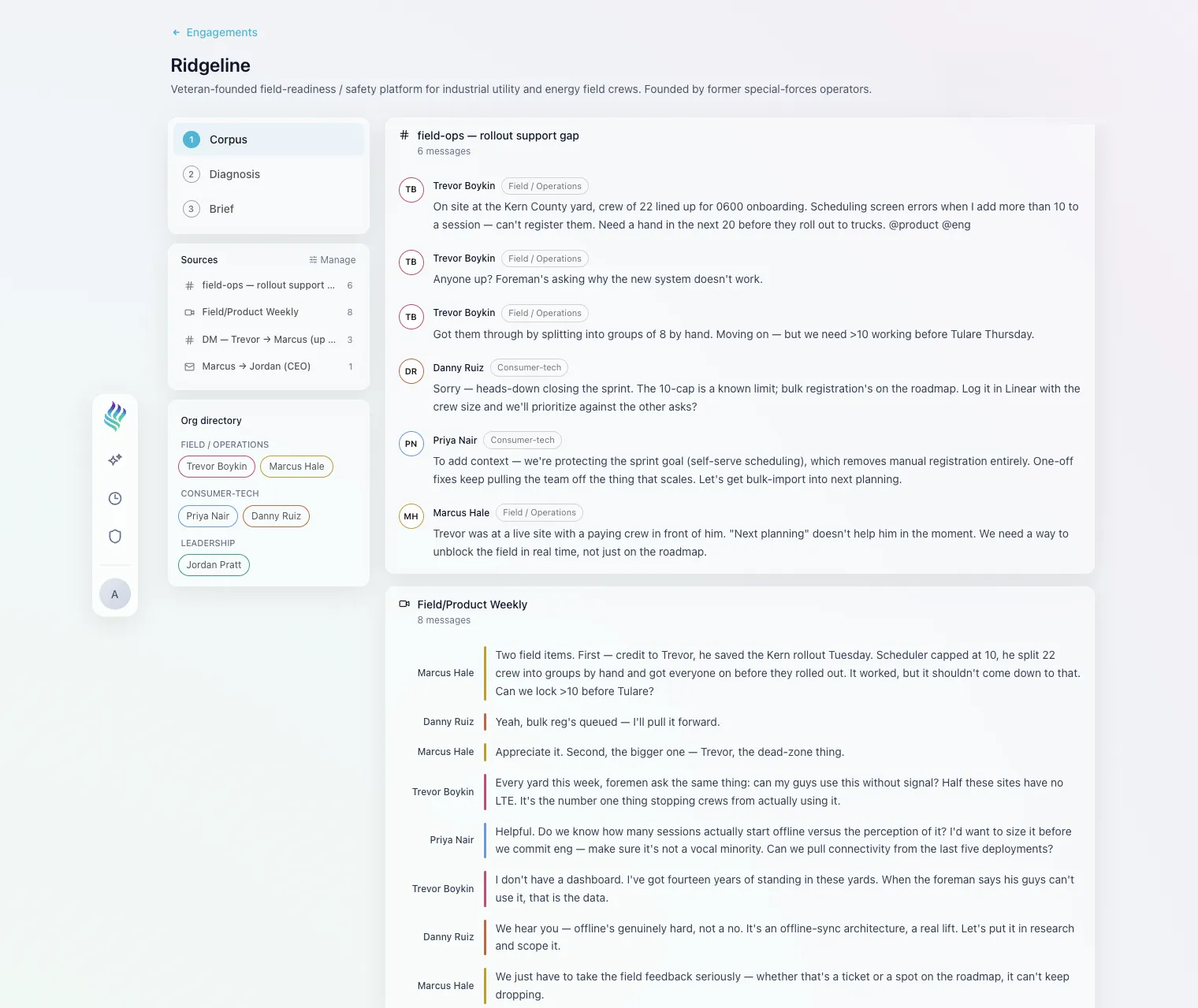
Ridgeline shared what already existed: Slack threads, weekly-meeting transcripts, DMs, an escalation email. Elumen organized it by source, person, and cohort; every message keeps its thread. No surveys, no new instrumentation.
Diagnosis: where the teams pulled apart.
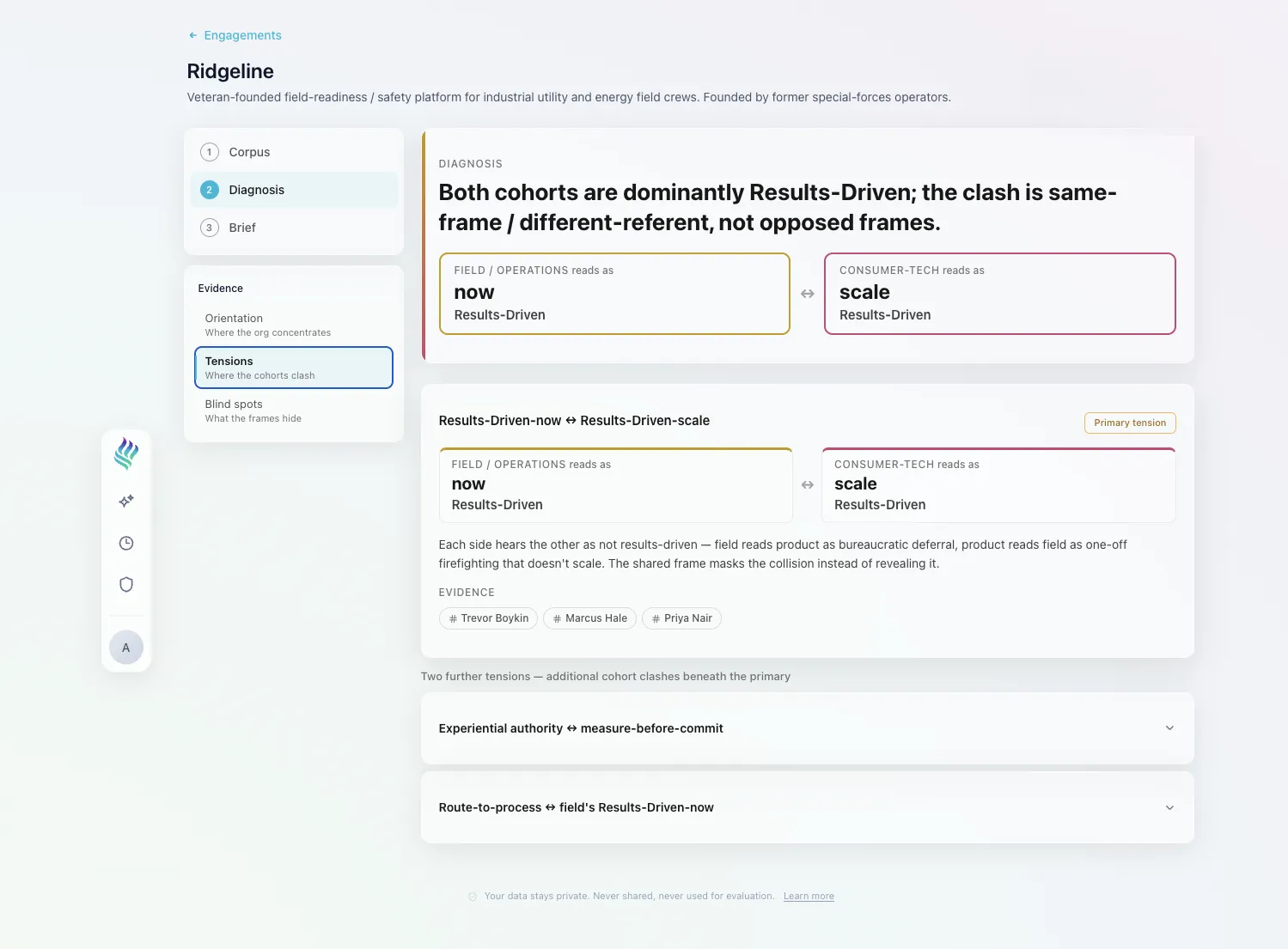
Elumen surfaced where field and product actually diverged: orientation, tensions, blind spots, and where each team's language concentrates. Every claim carries its evidence — each chip opens the source message in context, with the read beside it.
Brief: reframing options in the firm's vocabulary.
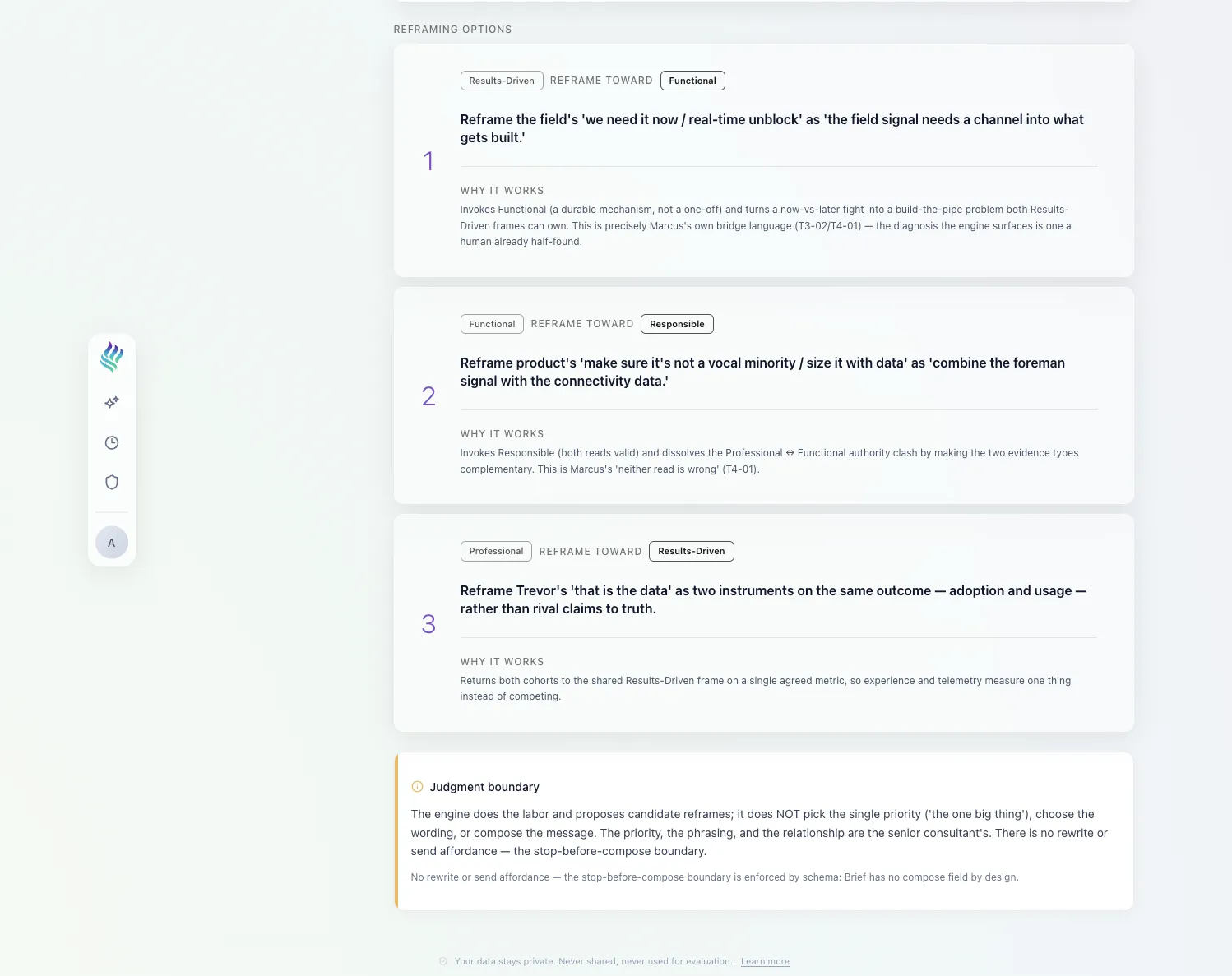
The brief stops where judgment begins: symptom, root cause, stakes, and reframing options phrased in the partner firm's own framework — each a move a partner can stand behind, not a message the machine wrote. The export is the complete brief, ready to stand alone.
The instrument's read, one message at a time.
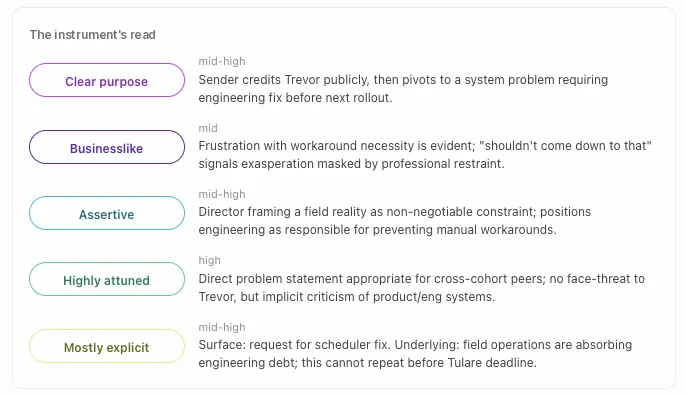
A full interpretive read of each message, with a confidence level on every call. Consistent interpretation, from the first message to the last.
The instrument your methodology runs on.
You share your methodology as your practice already teaches it: the deck, the docs, the definitions. We build its categories, its distinctions, and the patterns it watches for into the lens the instrument reads through. Not a prompt taped to a general-purpose model — a compiled lens, tried on your own material before any live engagement.
Underneath it, Elumen does the interpretive labor: a full read of every message, with complete provenance from claim back to source. The framework layer stays yours by design — the diagnosis arrives in the vocabulary your practice already works in, ready to take into the room with confidence. The Ridgeline engagement above runs a partner firm's framework brought in exactly this way.
Questions partners ask.
Does Elumen write the client communication?
No. The deliverable is the diagnosis and the brief; the recommendation, the relationship, and the writing stay with your people. That boundary is built into the product's architecture, not just its positioning.
What happens to the client's material?
It lives in an engagement-scoped silo, is never pooled across clients, is never used to train models, and is deleted on the schedule you set. Identity is pseudonymized on the consultancy side before ingest; names never reach Elumen. Full commitments on the Trust page — and in the contract.
How is this different from an AI notetaker, enterprise search, or an analytics dashboard?
Elumen delivers a diagnosis: the whole corpus interpreted through your framework, with every claim linked to its sources. Notetakers transcribe, search retrieves, dashboards count — none of them reads. What lands on your desk is a diagnosis you can defend, not a list of results.
Why not a general-purpose AI tool?
Elumen is built for the part that has to survive scrutiny: the diagnosis. Your framework is compiled into the instrument, the interpretation holds consistent across the whole corpus, and every claim traces back to its source. A general model with a good prompt can tell you what was said. Elumen tells you why it's misfiring — and hands you the diagnosis, the evidence, and the provenance your recommendations stand on.
What does evaluating Elumen look like?
Bring one engagement's worth of material. We configure the instrument with your framework, run the corpus, and walk your partners through the brief. If it doesn't change how you'd walk into that engagement, don't continue.
See how Elumen can improve a real engagement.
Start with a 30-minute working session.
Bring a real engagement when you're ready.